Watching Dead birds (1963) and To Live with Herds (1972) I was surprised to see how much the former resembles a contemporary ethnographic text and how little the latter. Where does the ‘ethnographicity’ of these films reside? Banks (1992) argues that a film is the outcome of a process that can be divided in three parts: the intention to shoot a film, which leads to the event of making it and the reaction to the final result. In which part of Gardner’s film resides the ethnographicity that makes it resemble a contemporary ethnographic text and in which part does it reside in MacDougalls’ film? Is ethnographicity present in the intention behind making the film, the event of making it or the reactions to the final product?
Gardner’s intention to salvage disappearing cultures with his cinematic practice and his reification of the film’s subjects in images which are used to support a general statement about humanity is far from what one would see in today’s ethnographies. Moreover, intervening in the subjects’ everyday life to direct their actions in order to enact the subject-image sought sounds outrageous to the present day anthropologists. His entire filmography has been criticised for these reasons and Jay Ruby’s (1991) essays are exemplary in this regard.
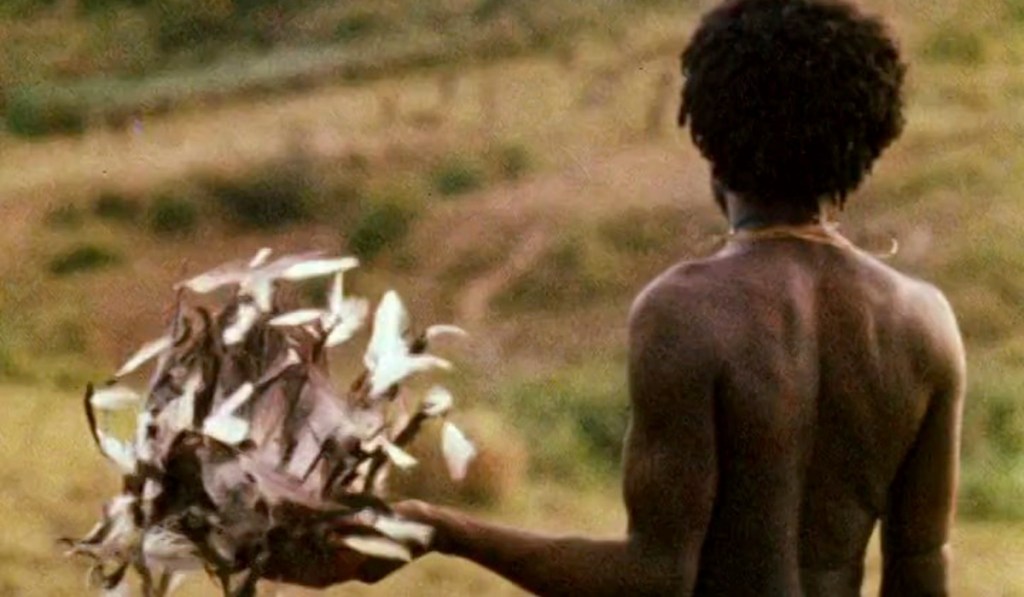
Another reason for which Ruby (1991, 6-7) and other anthropologists criticised Gardner’s work was his usage of commercial feature fiction conventions to edit his films. Ruby argues that the film is ‘constructed out of what is deemed necessary in order to have the film’s thesis look convincing’. This means that in order to deliver a compelling and comprehensive linear narrative Gardner fabricates the illusion of having shot coherent events by imposing meaning on disparate images. One example of this is the battle scene stopped by the rain. In this scene Gardner intercuts images from the battle field with images from the village where one of the film’s main characters is leaving his house to reach the battle. It would have been impossible for Gardner to shoot both scenes at the same time. The spatial unity of the scene is abandoned in favour of rhetorical unity which is achieved through a staging of the house leaving shot. This of course raises questions about the veracity of the scene and the capacity of the film to act as a record of reality that is not influenced or distorted by the filmmaker.
Ruby’s and other anthropologists’ critique of Dead Birds is addressed from the standpoint of the observational mode of documentary film, which evolved in contradistinction to the expository mode of Gardner’s film (Nichols 1991). Vaughan (1992, 100) argues that although the observational mode claimed to provide an unmediated relationship between the viewer and the film as record of reality few filmmakers adopted this stance. However, observational filmmaking ‘rested on the assumption, implicit or explicit, that the inevitable selectivity of shooting may be counteracted, or perhaps, merely atoned for, by a refusal of selectivity in editing: that the minimum structuring will afford the maximum of truth’. By the late 1960s this became the main mode of ethnographic filmmaking and to some extent it is still the main mode today.
In terms of intention, which is to observe the everyday life of people, and engagement with the subjects of the research, be as less intrusive as possible and guide the structure of the film according to the unfolding of their actions, observational film is more close to the contemporary ethnographic text. In fact, some have argued that observational filmmakers were the forerunners to the discussions about what sort of representations are ethnographic texts initiated by Clifford and Marcus (1986) in Writing Culture (Ginsburg 1998, Wright 1997).
David and Judith MacDougall’s first film To Live with Herds (1972) is considered a classic of the observational mode. Grimshaw and Ravetz (2009) description of what makes this film observational points out the main difference between the expository and the observational mode in terms of cinematic conventions employed. They say that ‘MacDougall sought to preserve the integrity of events and encounters witnessed’, rather than to deliver a compelling argument. In this manner the film is also ‘inviting viewers to engage with the materials on their own terms’ , instead of imposing meanings to the images in order to enroll them into a general argument, while ‘the relationship between the different parts [of the film] was not then straightforwardly linear, but emerged as a series of variations in theme and tempo’ (Grimshaw and Ravetz 2009, 83-84).
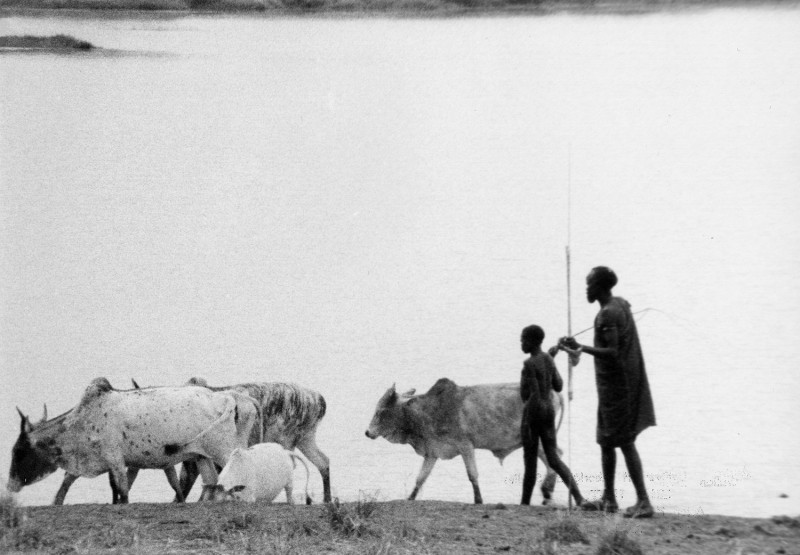
I believe that what makes Dead Birds resemble a contemporary ethnographic text more than To Live with Herds resides in the reaction part of the film process, rather than in intention or event. On one hand, Dead Birds, like ethnographic texts, uses a voice over, representing the ‘author’s’ voice. It explains the visual material or uses the visual material to support what the voice over is saying. Moreover, the visual material illustrates abstract ideas. For example, a juxtaposition of images of a puddle in which rain drops are falling followed by an image of a banana tree are used as visual metaphors for the idea that the human soul is conceived as a seed that grows in time. The voice over is always present throughout the film interpreting the images. On the other hand, To Live with Herds only provides explanations of images in intertitles at the beginning of each film segment, in which several scenes illustrate through images and overhead conversations or interviews what was mentioned in the intertitles. Sometimes a voice over is used to give information that was not captured by the camera. For example in the cattle market scene when at the end of the scene the voice over mentions that a buyer was ask if the cattle auction was successful or not and continues with the reply of the buyer over images that depict the market, the cattle and the people.
Images in Dead Birds are treated as ethnographic documents that need to be interpreted, just like fieldwork notes are interpreted in a text. Like ethnographic description made from various notes, a scene is fabricated from different observations and are embedded into a narrative that delivers the argument of the scene and each individual scene is placed into the overall narrative that supports delivers argument of the entire film. The voice over is overtly used throughout the film as the ‘author’s’ interpretative voice. In To Live with Herds instead, the interpretation appears at the beginning of each part in the form of intertitles which because of their formal style are less easily attributed to the ‘author’s’ voice and can be read as not interpreting the images that follows them. It feels like each part follows the IMRaD (Introduction, Methods, Results and Discussion) style of writing of the scientific text. Moreover, when the voice over appears, stylistically more personalised than the intertitles or than the ‘voice-of-God’ in Dead Birds, it is used to add more information, similar to a footnote, rather than to interpret the images. Hence the reason my reaction to seeing Dead Birds as more ethnographic has to do with employing conventions of using ethnographic documents that, interestingly enough, only during the 1990s will become mainstream in the ethnographic text (see for instance the article of Besnier (and Morales 2018), editor of the American Ethnologist, about how to write a publishable text for the journal). Gardner interprets the images and embeds them in a narrative, while the MacDougalls refrain from interpretation, or tend to veil it, as much as possible and refuse to create a narrative.
As Vaughan (1992, 100-101) has noticed ‘we may, indeed, find it a little puzzling that anthropology should have taken so readily to observational modes of film-making at all, when it might, as a science, have been expected to prefer the traditional patterns whose tight organisation of proto-fictional (or at any rate proto-demonstrative) materials promises to raise the general principle above the vagaries of the particular instances’. Although, to some extent the discipline of anthropology has discarded pretences to be a hard science and accommodates looser structures of argumentative reasoning, it is nonetheless geared in its textual form towards some form of generalisation that requires more tightness in the organisation of its ethnographic documents, more than what some anthropologists might want from their materials, more than the observational film conventions offers. Gardner’s usage of images which are embedded into a narrative that delivers the argument is much more similar to what the ethnographic text turned to in anthropology’s post-positivist era.
Whether the ethnographic film should be different from the ethnographic text, or whether the ethnographic text should be more akin to observational film is a related but somewhat different discussion.
References
Banks, M. 1992. Which films are ethnographic films? In Film as Ethnography, Crawford, P. I. and Turton, D. Manchester: Manchester University Press.
Besnier, N. and Morales, P. 2018. Tell the Story. How to Write an Article for American Ethnologist. American Ethnologist 45(2): 163-172.
Clifford, J. and Marcus, G. eds. 1986. Writing Culture. The Poetics and Politics of Ethnography. Berkeley: University of California Press.
Ginsburg, F. 1998. Institutionalizing the Unruly. Charting a Future for Visual Anthropology. Ethnos 63(2): 173-196.
Grimshaw, A. and Ravetz, A. 2009. Observational Cinema. Anthropology, Film, and the Exploration of Social Life. Bloomington: Indiana University Press.
Nichols, B. 1991. Representing Reality. Issues and Concepts in Documentary. Bloomington: Indiana University Press.
Ruby, J. 1991. An Anthropological Critique of the Films of Robert Gardner. Journal of Film and Video 43(4): 3-17.
Vaughan, D. 1992. [1978/79]. The aesthetics of ambiguity. In Film as Ethnography, Crawford, P. I. and Turton, D. Manchester: Manchester University Press.
Wright, C. 1998. The Third Subject. Perspectives on Visual Anthropology. Anthropology Today 14(4): 16-22.
 twitchingeyes