Viral images during the pandemic

In this entry I will discuss Viral, the short experimental video I am making about Romanian migrants returning home from, mainly, Italy during the COVID-19 pandemic.

In March 2020, after the first nation wide movement restrictions imposed by Italy as an attempt to stop the spread of the coronavirus epidemic, many of its Romanian migrant workers decide to go back home to Romania. There are 1 million Romanians in Italy and they are the largest migrant group in the country. Although Romanian migrants from Italy were the first, as restrictions measures were being taken by other European countries migrants drove or flew back home from everywhere on the continent. The number of Romanians who work and live abroad was estimated in a recent OECD (2019) report at around 3.5 millions in 2016. Out of these, according to Romanian customs statistics, around 250.000 returned from abroad in March 2020[1].

During those first weeks of March, the Romanian government reacted to the growing influx of returnees with some belated measures that cancelled flights to and from Italy and imposed a 14 days quarantine period for those returning home. From the terrestrial borders they were escorted into quarantine. Several of those returning to Romania used their smartphones to live stream on Facebook from the border, while being escorted into quarantine and from the quarantine location. They complained that there are families with kids and elders and are kept at the border or are being escorted for more than 12 hours without the possibility of getting food or water or even going to the restroom. In the quarantine locations they complained about the same lack of food or water, but also unsanitary premises. These people transformed into citizen camera-witnesses, a term used by Andén-Papadopoulos (2014, 754) to describe ‘camera-wielding political activists and dissidents who put their lives at risk to produce incontrovertible public testimony to unjust and disastrous developments around the world, in a critical bid to mobilize global solidarity through the affective power of the visual.’

As soon as news these videos became viral online and got picked up by TV news stations, Romanians from abroad and at home started to share their opinions by posting or live streaming online video messages. Many of them insulted those who travelled back home, accusing them of bringing the disease into Romania and of not being the real Romanian diaspora but marginals: ‘whores, pimps, beggars, thieves, gypsies’ etc.

By mid March 2020, Hungary shut its borders for foreigners as a measure to contain the spread of the virus and many of the Romanian migrants returning home from Italy, but also from Germany or France, were blocked at the border crossing between Austria and Hungary. Several of those stuck there transformed themselves in citizen camera witnesses and started live streaming on Facebook, urging their viewers to share the video so that it can reach the Romanian authorities, but mainly the president Klaus Iohannis who they said they voted. The video messages of those that stayed and those at home reacting to the live streams from the border became also more virulent.

Resentment about the centrality of the diaspora in the past three electoral cycles was surfacing in these messages. In the past decade the diaspora was placed between the two political camps in Romanian party politics. On one side, the Social Democrats and, on the other side, the Liberals (I include here not only the Party of National Liberals, but also the Party of Democratic Liberals – although not always on the same page on punctual matters, their overall ideological agenda was the same).

Juxtaposing the citizen camera-witness footage I collected online from Facebook and Youtube, the video explores how the pandemic engendered a political field of contention with different voices drawing from an already established repertoire of tropes surrounding the identity of these migrant workers as diasporic community and adding to this repertoire the new image of the diaspora as a medium of virus transmission.

The diaspora’s political agency

The Social Democrats are the heirs of the pre-1990 Communist Party of Romania and the burden of this legacy has defined its public identity. On top of this, the party’s promises of increasing social welfare benefits has been the main strategy of securing the votes of the disadvantaged population, the majority of Romania’s population, and was criticised by the Liberals for generating budget deficits and debt to cover them. Moreover, widespread corruption amongst its high ranks has contributed to the negative image of the party and the intensification of the anti-corruption prosecutions in the past decade has decimated its top echelon and replaced it with low rank figures that have been not only unable to fight back their Liberal opponents but further weakened the party through poor public performances and unpopular policies. The Liberals’ discourse framed the Social Democrats and their politics using the term ‘red pest’ and the Liberals placed themselves in an almost messianic role of getting the country rid of the disease.

The Liberals instead have struggled since the 1990s to create an electoral base. After successfully relying for support in the mid 2000s on a credit backed middle class, the global financial crisis and the consequent austerity measures taken by the Liberal government shrank the ranks of the middle class. Cases of corruption also amongst its high ranks, like those of the infamous president Traian Basescu (2004-2012) and of his close circle, led to a drop in the popularity of the Liberals. In this context PSD’s more welfarist governing program took over the helm of the country in 2013. Together with the articulation of the ‘red pest’ discourse, another strategy of the Liberals’ in the struggle to reconstruct an electoral base was based on empowering the diasporic community, which grew in number after the EU accession of Romania in 2007.

The diasporic community made its appearance on the political stage for the first time during the 2009 presidential elections, when, according to many political analysts, their votes were crucial in deciding between the Liberals’ Traian Basescu and the Social Democrats’ Mircea Geoana (Burean 2011, Gheorghita 2011). At the next presidential elections in 2014, where the Liberals’ Klaus Iohannis competed with the Social Democrat’s Victor Ponta, the diaspora became even more important (Gherasim-Proca 2014). Using their camera-phones and social media to record and make visible the long queues, the protests over not being able to vote at the polling stations abroad and the interventions with tear gas of the authorities in Paris and Turin, they became active citizen camera-witnesses and entered the radar of public debates.

Queuing at the polling station during the presidential elections of 2014 in Milan.
Queuing at the polling station just before their closing during the presidential elections of 2014 in Turin. People are shouting ‘We want to vote!’
Queuing at the polling station during the presidential elections of 2014 in London.
Queuing at the polling station during the presidential elections of 2014 in Paris.

The political agency of the diaspora pushed politicians to position themselves in regards to the themes that placed Romanian emigrants on the European and national public agenda since 2007 (Beciu et al 2018). One important theme was that regarding Romania’s cultural image that the diaspora promotes abroad. Distinctions emerged between the good law-abiding immigrant that promotes a positive image of Romania and the bad crime-involved immigrant that is detrimental to the country. To legitimise the diaspora’s political agency, the Liberals were mostly framing the Romanian migrants in terms of the good immigrant, while the Social Democrats tended to resort to the bad immigrant image to define the diaspora and delegitimise its votes.

Another important theme was related to the economic role of the diaspora. Between 2007-2017 the diaspora’s remittences represented on average 2,5% of the GDP. In the aftermath of the global financial crisis the Liberals used the remittences data to further legitimise the diaspora’s political agency as their money were framed as a major support to the Romanian economy in difficult times, while the Social Democrats contested the usefulness of these remittences.

These debates and the diverging positions of the political parties and the media in regards to the diaspora helped construct not only a split within the diaspora, the good migrants vs the bad migrants, but also a split between ‘them’, Romanians abroad, and ‘us’, Romanians at home. The former were ridiculed and mocked when returning home speaking Romanian with Italian accents and mixing words from the two languages. The acquisition of new expensive cars and the construction of large vilas at home, markers of their financial success, were derided as empty signifiers, deployed by the diaspora to distinguish themselves although in actuality only veiling the same miserable living conditions they face abroad as those who remained at home.

The important role of the diaspora in electoral politics was again confirmed during the 2019 presidential elections when the votes of the Romanian abroad secured the victory of the incumbent Klaus Iohannis against the Social Democrats’ Viorica Dancila.

At the border

One of the main themes of the videos made by the citizens camera-witnesses in 2014 during the elections was the long queues at the polling stations. The queue has a cultural significance in Romania as the last decade of socialism is remembered as a time of shortages and austerity and long queues for rationed staple food (Campeanu 1994). It is a powerful popular symbol representing the the state’s opression or disregard of its constituent population. The videos from the returnees blocked at the Austrian-Hungarian border picked up the theme of the queue. Many of the videos are showing the long lines of the cars with the footage producers walking amongst the queuing cars and stating their estimates of the length of the queue.

Romanians blocked at the border between Austria and Hungary 17 March 2020

How can this appropriation of the queue be interpreted? It could be seen as an unconscious adoption of an already established aesthetic and argumentative genre of the citizen camera-witness. But it could be seen also as a conscious adoption of the genre and its usage as a formula for getting viral online and producing political effects. This time, however, some things changed since 2014. Those recording the footage do not criticise the authorities for failing to take care of the diaspora, but summon their help and especially the help of the president they voted, Klaus Iohannis, reminding him of the effort they put in voting him into office. They ask Iohannis to stand up to its electoral promises of representing Romanians at home and abroad.

The recurrent themes regarding the political, economic and cultural aspects in the public debates about the diaspora since 2007 were also picked up in the video messages of the Romanians at home who were condemning those stuck at the border for voting Klaus Iohannis and told them to remain abroad. They told those at the border ironically that only by staying there they can make the money they claim they make and with which they allegedly keep Romania’s economy alive. The Romanians abroad who decided not to travel back also distanced themselves from those who returned home. They claimed that those who stay abroad are the real diaspora, the good immigrant, because their family, their life is there, they integrated and they have no reason to go back. Those who leave are the bad immigrant, the ‘whores, pimps, beggars, thieves, gypsies, scum’.

Video message from a Romanian living abroad about the Romanians returning home March 2020

Viral

In my video I appropriate footage I collected online from Facebook and Youtube. As I mention in my previous entry, in the digital age the filmmaker is not anymore the sole producer of footage. In fact, the availability of camera-phones has led to a proliferation of ‘amateur footage’ and many filmmakers have used this type of material for its self-representational value. Treating the footage as self-representational, the filmmaker becomes a critical viewer rather than a maker, and, instead of holding a camera, s/he curates and facilitates access to already existing footage.

I appropriate this footage that deals with the return of migrants from Italy back into Romania as cultural artefacts. By this I mean that the footage embodies the cultural dispositions of those that produced it and are to a certain extent representative of a shared collective experience. The footage-artefacts index social relations and interactions that define particular world-views, that is frames of sense making that make intelligible performative speech acts. Moreover, these artefacts themselves have agency, since their viral circulation online creates affects and leads to a proliferation of artefacts that are linked to each other in a network constitutive of the political field of contention regarding what the diaspora is and does.

Natalie Bookchin Testament (2009)

My inspiration for the video came from Natalie Bookchin’s video artwork Testament (2009). In this work she uses online vlogs that she groups according to different topics. Initially conceived as a multi-channel installation, she edited the different footage into one single video that shows the shared experience of losing a job, being on anti-depression medication and trying to come out. The edit creates a polyphonic narrative by overlapping the different footage so as to complement each other and give the sense of a single homogenous narrative. Although not explicitly mentioned, since most of the testimonials are in US English and all the vloggers seem to actually be US citizens, this shared experience is grounded into the US culture and thus speaks about the topics addressed in the videos not from an universal vantage point, but from their local articulation in the US.

Unlike Bookchin I use her visual grammar to portray not a single narrative, but multiple, opposing narratives of shared experience – the articulation network constituting the field of contention over the identity of Romanian emigrants. It is the conflicting nature of the multiple voices I bring together that I believe ends up defining the collective shared experience of the Romanian diaspora going back home.

Is this the end?

After two days of blockage at the border between Austria and Hungary, the Romanian Minister of Foreign Affairs managed to negotiate with the Hungarian authorities the creation of a ‘humanitarian corridor’ that would allow Romanians to transit the country. However, the Romanian president urged the diaspora not to come home.

The arrival of 250.000 Romanian citizens into the country in the first two weeks of March already posed serious logistic problems in enforcing the quarantine and self-isolation measures imposed by governmental decrees according to international standard procedures. When paired with statistics on the number of quarantined and self-isolating people, it emerges that more than half of those that arrived in the country are not accounted by the authorities in charge with the management and enforcement of the measures taken[2]. Moreover, a recent report from the National Institute of Public Health confirms that the virus was imported from ‘Italy’ and other Western European countries.

As the number of cases continue to rise in Romania, people continue to return home from abroad, the national medical system shows signs of being on the bring of collapse, and the economy of most of the receiving countries and at home are in crisis, it remains to be seen how the diaspora will come out of the coronavirus story once it will all be over.

Notes

[1] However, numbers are not clear. Other sources talk of at least 1 million returnees (see https://romania.europalibera.org/a/%C3%AEntre-200-500-%C8%99i-950-500-de-persoane-intrate-%C3%AEn-rom%C3%A2nia-au-sc%C4%83pat-de-carantin%C4%83-%C8%99i-izolare-testa%C8%9Bi-%C3%AEntre-0-82—3-29-/30499768.html). Others of 800.000 Romanian emigrants returning in the first weeks of March (see https://www.economica.net/sociopol-800-000de-romani-s-au-intors-in-ara-in-doua-saptamani-doar-400-000-recunosc-ca-au-facut-o-de-frica-coronavirus_181635.html).

[2]See https://romania.europalibera.org/a/%C3%AEntre-200-500-%C8%99i-950-500-de-persoane-intrate-%C3%AEn-rom%C3%A2nia-au-sc%C4%83pat-de-carantin%C4%83-%C8%99i-izolare-testa%C8%9Bi-%C3%AEntre-0-82—3-29-/30499768.html

References

Andén-Papadopoulos, Kari. 2014. “Citizen camera-witnessing embodied political dissent in the age of ‘mediated mass self-communication'”. New Media & Society. 16.

Beciu, Camelia, Mălina Ciocea, Irina Diana Mădroane, and Alexandru I. Cârlan (eds.) 2018. Debating migration as a public problem national publics and transnational fields. New York, N.Y.: Peter Lang.

Burean Toma. 2011. “Political Participation by the Romanian Diaspora”. In Paul E. Sum and Ronald F. King eds. Romania under Băsescu: Aspirations, Achievements, and Frustrations during His First Presidential Term, Lanham: Lexington Books, 83-105 

Câmpeanu, Pavel. 1994. România: coada pentru hrană, un mod de viață. București: Editura Litera.

Gheorghita, Andrei. 2011. “Vote Transfers, Thwarted Voters and Newcomers in the 2009 Presidential Runoff in Romania”. SOCIAL CHANGE REVIEW 9 (2).

OECD. 2019. Talent Abroad: A Review of Romanian Emigrants. Paris: OECD Publishing.

Ovidiu Gherasim-Proca. 2015. “Alegerile prezidențiale din România (2-16 noiembrie 2014). Hipermobilizare și eșec administrativ”. Analele Ştiinţifice ale Universităţii ‘Alexandru Ioan Cuza’ din Iaşi. Ştiinţe politice 10:103 – 117.
Forms of interaction and reflexion in the digital age

The innovations brought by Rouch and Morin’s Chronique d’un été (1961) in terms of forms of interaction and reflexion in filmmaking were enabled by technological changes. Mobile film cameras and sound recorders allowed the synchronous recording of sound and moving images, placing the filmmaker in-the-world-in-action. These changes were integral to Rouch and Morin’s project which was motivated by questions like: what sort of interaction between the filmmaker and the filmed subject can this camera engender? What is the status of the filmmaker? How is this new position of the filmmaker with the camera in-the-world-in-action influencing what the camera records?

The rise of new media, particularly mobile telephony, the internet, digital video and especially the incorporation of these three intro a single device – the smartphone – gave birth to new forms of interaction and reflexion in filmmaking.

Interaction

In The Digital Age the filmmaker is no longer the exclusive producer of footage. The relative cheapness of smartphones allows almost everyone to become a smartphone user and almost instantly produce their own footage and consume their’s and others’. This ability of making one’s own footage is not new. Cheap film cameras and then VHS and digital camcorders have been available since the mid-20th century leading to a proliferation of home movies offering a glimpse into private everyday life and citizen witnessing footage of major public events.

The novelty resides in the interaction between the filmmaker and this type of self-representational footage. Experimental and fiction filmmakers have appropriated the aesthetics of this footage because of its contestation of established filmmaking conventions. Jonas Mekas has extensively appropriated this aesthetic in his films shot on 16mm camera, considered to be an amateur, home movie format.

Jonas Mekas Reminiscences of a Journey to Lithuania (1972) – excerpt

George Kuchar’s video diaries shot with a VHS camcorder are another example of appropriating this aesthetic.

George Kuchar Weather Diary (1986)

More recently Charlotte Prodger appropriates this aesthetic employing the smartphone camera. She won the Turner Prize for her two channel video installation ‘BRIDGIT/Stoneymollen Trail‘ shot with an iPhone. Tate’s director Alex Farquharson, the institution that selects the jury and organizes the award, said that ‘BRIDGIT’ represents a breakthrough, and a use of a technology we’re all familiar with to make something that is profound.”

Charlotte Prodger BRIDGIT (2016) – excerpt

Documentary and experimental filmmakers have also ‘recycled’ this type of footage and incorporated it into new structures of meaning. A famous example is Alan Berliner’s The Family Album (1988), which is based on anonymous home movie footage and home made audio recordings he bought or received from friends and family. Berliner weaves the footage and sound recording to create a narrative about ideal-type ‘American family’.

Alan Berliner The Family Album (1988)
1989 Interview with Alan Berliner about The Family Album (1988)

A more recent example of this is Dean Fleischer-Camp’s Fraud (2016). He uses the home video footage found on a family’s Youtube channel to construct an “impressionistic meta-fiction thriller that reveals one family’s struggle for the American Dream and the mutability of the stories we tell online”.

Dean Fleischer-Camp Fraud (2016)

Other filmmakers though, have used this type of material for its self-representational value. It is this relation between filmmaker and footage that can be said to be interactional. Treating the footage as self-representational, the filmmaker does not produce images but interprets them in relation to their producer and the context in which the footage was taken. The filmmaker inhabits the place of the critical viewer, the compiler, the curator of or the facilitator of access to the footage. This interaction can also take different forms.

It can be an interaction with the footage as a cultural artefact. Peter Forgacs Private Hungary (1988-2002) series is a well know example of this kind of interaction between filmmaker and self-representational footage.

Peter Forgacs The Diary of Mr. N – Private Hungary 4 (1990) – excerpt

Gustave Deutsch’s ADRIA – Holiday films 1954-68 (The School of Seeing I) (1990) is another classic example. Deutsch uses home movies from Austrians on holiday at the Adriatic Sea. Nevertheless, unlike Forgacs, who utilizes Ginzburg’s venatic mode of deduction to make a statement about Hungarian society based on the home movies footage, Deutsch analyses the visual grammar of home movies to articulate it as a homogenous body of work that expresses shared cultural dispositions of the Austrian amateur filmmaker. The same sort of approach is adopted by Jasper Rigole in Paradise Recollected (2008).

Jasper Rigole Paradise Recollected (2008)

Natalie Bookchin Testament (2009) uses online vlogs that she groups according to different topics: getting laid off, using medication for treating depression and sexual orientation. The different testimonials she employs are edited to show how they overlap, complement each other, portraying the shared experience of losing a job, being on medication and coming out as being gay. Although not explicitly mentioned, since most of the testimonials are in US English and all the vloggers seem to actually be US citizens, these shared experiences are grounded into this particular cultural space.

Natalie Bookchin Testament (2009)

But it can also be a collaboration between the filmmaker and the footage producer done through a call to participation. In these cases the footage producers actively participate in the making of the film, although there are different degrees of participation. In Life in a Day (2011) Youtube users were invited to upload video of their July 24th 2010, which were edited in a feature film by Kevin Mcdonald. The users collaborate with the filmmakers in the production of the film, but not in the final creative decisions.

Kevin Mcdonald Life in A Day (2011)

In the MyStreet project (Stewart 2013) the videos are uploaded on a dedicated platform and then can be accessed through an interactive map. In this case the filmmaker is “orchestrating levels of user agency through software” (Gaudenzi 2014, 135). The footage producer participates not only in the production of the film by sharing his footage, but also in the creative decision-making, since the videos uploaded are not further edited by the project initiator.

Reflexion

In The Digital Age, the footage made by the smartphone users by-passes the mediation of the filmmaking industry and reaches the audience more directly. Instead of going through production and distribution companies to reach formal consumption sites like TV stations or film theatres, the internet links users and audience through social platforms like Youtube, Facebook, Twitter, Instagram, etc. But the platforms also redefine the audience. If once home movies where destined for ‘home’ audiences and thus made in a ‘home mode of production’, now they are addressed to a larger and often anonymous audience creating a shift in how this footage is being produced.

This situation takes me back to Rouch and Morin’s Chronique. How is the smatphone camera influencing what the camera records? Unlike in Chronique, where Rouch and Morin have to break established conventions to create the space for such a reflexive gesture, in the footage generated with the camera this reflexivity is in-built. The self-representational footage never masks its production process. The camera and the user are part of the recording subject, whether the camera is directed at the user or the user is heard off-screen and felt in the more erratic camera movements.

The shift from the home mode of production to a public mode of production, whether driven by the monetary logic of Youtube (Berliner 2014) or political intentions (Anden-Papadopolous 2014), is seen in how the the user performs the self in the footage, who now greets the anonymous audience and summons the viewer to “Look!” and “Share!”. The camera becomes a mean of attracting attention to oneself’s lived experience, to make it a viral object that can circulate throughout the network, where “viral patterns of movement characterize the turbulent spaces of networks as a very primary logic” (Parikka 2007).

Video of Asmaa Mahfouz that mobilized Egyptian to protest, leading to the 2011 Egyptian Revolution

Despite the in built reflexion the self-representational footage brings, many of the filmmakers interacting with this type of footage did not reflect on their relation with the footage. One possible way of integrating reflexion is by turning the filmmaker in the smartphone footage producer that summons the audience to look and share the recorded experience of viewing self-representational footage. An interesting strategy that could be appropriated for this purpose is the one employed by Godard in his Histoire(s) du cinéma (1988-1989). Although the footage he uses is not ‘amateur’, the way in which he inserts, beside the his own voice commentary, interspersed shots of himself reading, writing and editing can be one possible way for the filmmaker as critical viewer to be reflexive.

References

Andén-Papadopoulos, Kari. 2014. “Citizen camera-witnessing embodied political dissent in the age of ‘mediated mass self-communication'”. New Media & Society. 16.

Berliner, L. 2014. Shooting for Profit: The Monetary Logic of the YouTube Home Movie. In Young, G., Rascaroli, L., and Monahan, B. 2014. Amateur filmmaking: the home movie, the archive, the web. New York: Bloomsbury.289-300.

Gaudenzi, S. 2014. Strategies of Participation: The Who, What and When of Collaborative Documentaries. In New Documentary Ecologies. Emerging Platforms, Practices and Discourses. Nash, K., Hight, C., and Summerhayes, C. New York: Palgrade Macmillan.

Stewart, Michael. 2013. “Mysteries reside in the humblest, everyday things: collaborative anthropology in the digital age”. Social Anthropology. 21 (3): 305-321.

Forms of interaction and reflexion

Chronique d’un été (1961) co-directed by Jean Rouch and Edgar Morin is recognised as one of the most innovative documentary films made. The most important innovations of the film relate to what Nichols (1991) calls the interactive mode of representation, introduced for the first time by Flaherty in Nanook of the North (1922), and the reflexive mode of representation in documentary film, first seen in Vertov’s Man with a Moving Camera (1929). Rouch (1974) calls these two filmmakers the first geniuses. Chronique brings together and redefines these modes of representation into a new form of documentary film that is often referred to as cinema verite. The strength of this film lays in my opinion in this interplay between interaction and reflexion, because it shows how one depends on and informs the other. I want to outline in this entry the forms of interaction and reflexion present in the film, their mutual constitution, and explore how they influenced and were influenced by documentary filmmaking, ethnographic film and anthropology.

Interactions

The interaction mode of representation refers to the display of the encounter between the filmmaker(s) and the subjects of the film (Nichols 1991). First, the most common form of interaction in documentary film is through interviews. This interaction was made possible by the portable synchronous sound recording equipment developed in the 1950’s. In Chronique we see the directors interviewing, especially Morin. The latter interviews Mary Lou, the Italian immigrant working in the redaction of the famous Cahiers du Cinema, Jacques and Simone, a middle-class family, Jean Pierre, a student and his former lover Marceline, a researcher, and even his own children. This type of interaction has become ubiquitous in documentary, TV and sometimes one can see it in fiction film too. It is also still one of the most utilised methods of gathering qualitative data and there is probably no anthropological or ethnographic work, visual, textual or otherwise, that does not employ interviews.

Second, the filmmakers interact by creating situations for conversations to take place between the subjects and themselves. The scenes where several people stand at a table drinking and discussing are very much part of this type of interaction. As is the Saint Tropez trip. One exemplary scene is when Rouch asks at one of these get togethers the African students at the table if they know what Marceline’s tattoo represents, provoking a conversation about the cross cultural perception of tattoos, numbers and the Holocaust. Another one of these scenes is the one when Morin introduces Landry, the African student, to Angelo, the worker at the Renault factory provoking a discussion about racism and working class living conditions. This form of interaction has also become pervasive in documentary film and TV shows. Michael Moore’s Roger and Me (1989) is a famous example of documentary film uses this type of interaction. A more recent and successful documentary using this form is Joshua Oppenheimer’s The Act of Killing (2012), where a member of the far right paramilitary group that killed 1 million people in the 1960s in Indonesia for alleged communist affiliation after a failed coup is confronted with his killing practices. But it can be seen also in reality TV shows like An Idiot Abroad (2010-2012) or The Amazing Race (2001- ). This form of interaction anticipated the dialogic turn in anthropology, popularized in the early works of Crapanzano (1980), Dwyer (1982) and Rabinow (1977). In ethnographic film one can see it pushed to a more complex situation in Stephane Breton’s Eux et moi (2001).

A third form of interaction is one in which the filmmakers encourage the subjects to create and perform psychodramas (or sociodramas). This is a ‘strategy of encouraging subjects to play out their lives before the camera in order to release otherwise hidden aspects of their imaginations’ (Henley 2010). It has been a form present in Flaherty’s Nannok from which Rouch got inspired and which he used before and after Chronique in some of his ethnofictions: Moi, un noir (1958), La pyramide humaine (1961), Jaguar (1967), Petit a Petit (1969), Cocorico Monsieur Poulet (1974). Most of the observational footage showing the main characters in Chronique is played out by the film’s subjects. But the one which had the most impact is the scene of Marceline walking through the Concorde Square, recounting her father’s and her family’s experience in the concentration camps. This form of interaction in ethnographic film developed into a body of visual and textual work that promotes indigenous media production. It has also been fairly present reality TV shows, as well as in documentaries, like in Born into Brothels (2004), the Academy Awards winner of best documentary feature film. In the latter, the representation of sex workers’ children lives through their own photographs of their everyday becomes more militant – telling their story themselves is not only for the visual pleasure but to instigate the viewer to action and to give them representational agency. Renzo Martens used the same form of interaction but to a different effect in his Episode III: Enjoy Poverty (2008), where the empowering of the subjects never occurs and the promise of a better life turns out to be an illusion. The problem with this form and the previous one is that it always borders the limits of what is ethical. In fact, most of the films employing these forms are criticised for their ethical position.

A fourth type of interaction is between the subjects and their visual representation created by the filmmakers, which is done at the end of the film. In a sense this third form contains the previous, second form. The directors create the situation for conversations to take place between the film’s subjects and themselves but in this case the conversation is mediated by how the filmmakers represents the subjects. The filmmakers are not only the creators of the interactive situation but also its subject, opening themselves up for criticism coming from their subjects. This ‘feedback strategy’ has been a less explored form of interaction on display in documentary or ethnographic film, although it has been used by filmmakers in the process of making the film. However, this might be one way of avoiding the problematic ethics of the two previous forms, even though it did not help much in the case of Chronique.

Reflexions

According to Nichols (1991), the reflexion mode of representation is one in which the focus is on the filmmakers’ encounter with the audience. The process of representation basically becomes a subject of the film, like in the scene of Chronique were the subject watch the edited film. As Nichols (1991) argues, the interactive mode of representation is a form of reflexivity. Hence, the forms of interaction outlined above overlap with the forms of reflexivity used in Chronique. Nichols (1991) identifies two major forms of reflexivity, political and formal, as well as five variations of the formal form: stylistic, deconstructive, interactive, ironic and parodic/satiric.

Out of these, one of the forms used in Chronique is the stylistic reflexivity, achieved by breaking with the convention of documentary film that the filmmakers should be invisible. This has been done before by Vertov in his Man with a Moving Camera. Unlike in the latter, the man with the camera is not seen in Chronique, but the filmmakers are seen as recurrent characters in the film and the sound equipment, the technological innovation that made this film possible in the first place, is revealed in the last scene taped to Rouch’s body. Often the interview interaction form is used in conjunction with this form of reflexivity. The filmmakers are not only interacting with their subjects through the interview or by creating conversational situations but they are also shown doing it. And, like the interview interaction, this form of reflexivity has become mainstream. Hence, a convention that a contemporary reflexive film would need to break in order to expose its conventionality?

The second form of reflexivity is outlined by the presentation of the motive and method of the film in the beginning and in the conclusion at the end of the film. This is also a stylistic reflexion that makes the film narrative logic resemble more a scientific paper than a novel, breaking in a way with the poetic perspectives seen in Flaherty or Grierson. The directors achieve this reflexivity in the introduction of the film both by using a conventional voice commentary over establishing shots, but also through a conversation between the two filmmakers and one of the main characters of the film that follows the establishing shots. The voice over says that this is “a new experience of cinema verite”, while Morin develops the intention addressing Marceline: “What Rouch and I want to do is a film about how you live […] what do you do with your live”. The voice over says how this is done “[t]his film was not played by actors but was lived by men and women who devoted some moments of their existence”, while Morin says to Marceline that she will not know the questions they will ask and that in fact they don’t know them either. A similar stylistic reflexivity can be seen also in Trinh Minh-Ha’s Reassemblage (1982).

The first mode of representation of the motive and methods positions the film in a conventional expository mode of representation typical of Flaherty and Grierson, the second places it in the observational mode (see Nichols 1991 about the characteristics of these modes – if also discussed them in a previous post). I wonder if this has been an accident or if it is the result of disagreement between the directors. It clearly marks a breaking point in Rouch’s style, who prior to Chronique employed the expository mode and after it resorted more to the observational one. But regardless of the reasons, this apparently redundant edit manages to create an interesting deconstructive effect, similar to the one in Chris Marker’s Letters from Siberia (1958) scene where the same footage is shown three times in a row using each time a different voice and soundtrack re-signifying the footage and thus radically altering the viewer’s perception of it. It shows that the directors were not reflexive only about the scope and method of their inquiry but also the visual form it takes. Several decades after Chronique Timothy Asch and Napoleon Chagnon have employed this deconstructive reflexivity in their Yanomami series, of which the 30 minutes The Ax Fight (1975) is the most well known. In Reassemblage Trinh Minh-Ha also uses repetition to create a deconstructive effect. Her strategy is closer to that of Marker than that of Rouch and Morin or Asch and Chagnon.

The Ax Fight however raises some questions about the relation between reflexivity and interaction. Namely, how much of the interaction between filmmakers and their subjects is reflected upon? It has been suggested that the fight was provoked by the filmmakers, who in their attempt to interact with the Yanomami have traded objects like machete’s and that this created conflicts within their society over who has access to these resources. Hence, the fight is less the result of some inherent predisposition to align oneself with the more genetically close member of the group than the result of struggle over resources. When confronted with this hypothesis in a interview for Adam Curtis’ The Trap (2007) Chagnon got angry and left the interview. But Chronique manages to address this problem in a form of ethical reflexivity. The most eloquent scene in this regard is the one where Rouch, Morin and Angelo discuss about the problems the latter has encountered at work with his supervisor that might have been caused by his participation in the film.

Rouch and Morin also employ an ironic reflexive form. It appears at the beginning when we find out that the filmmakers will ask questions to people about how they live and first they will start with Marceline who says that she works as a researcher in a marketing research company and that her job is to make interviews, analyse them and report the findings – which is what Rouch and Morin are doing. When Rouch asks if she likes it she replies “No, not at all!”. Then the next scene shows her on the streets of Paris asking people if they are happy. It is used both in Reassemblage and in Martens Episode III: Enjoy Poverty extensively. The ironic reflexivity however is not used often for, like in the interaction forms on which it rests, is always tinkering the limits of the ethical.

The ironic reflexivity moves into parody and satire in the scenes from Saint Tropez when Sophie, ‘a cover girl’ becomes one of the character of the film and a conversation between her and Landry about Western visual culture begins. The parodic and satiric emerges because of the intervention of the filmmakers in creating this conversation and the cross-cultural interaction between the film’s subjects. Landry is paired with Sophie to reveal the double standards of the Westerners, between nudity at home, the women in bikini followed by photographers, and nudity in the colonies, the women in certain region of Africa that wear only a leave and are being laughed at. The visual juxtaposition between Landry who is fully dressed, unlike the image of the African men in ethnographic films, walking side by side with Sophie, who wears her cover girl revealing shorts and top, is elaborating on the self-reflexive parody/satire form. This reflexion becomes more clear towards the end of the film, when after the screening of the film to the film’s subjects one of the women in the audience criticises the emotional exposure of Mary Lou during the interview with Morin as being too indecent. It shows how conventional and acceptable the cover girl body exposure became in visual culture, although as Sophie says, she does it only for money, it’s a job, a pose, a pretend, and how the directors’ exploration of the possibility of revealing someone’s authentic self in front of the camera is both disrupting and reproducing this convention.

Another form of reflexivity, a political reflexivity, is present in the content not the exposure of the intention of making the film. A voice commentary over establishing shots of Parisian street life announces that “[t]his film was not played by actors but was lived by men and women who devoted some moments of their existence to a new experience of cinema verite”. The scene ends and the next one starts with Rouch addressing Morin and saying that the idea of bringing people at the same table (literally) to have a discussion is an excellent idea, but: “I am not sure if we will be able to record a normal conversation as if the camera wouldn’t be present”. Rouch turns towards Marceline and says “for example, we don’t know if Marceline will be able to relax and be able to have an absolutely normal conversation”. Morin replies “she can try”. Reflexivity here is an inquiry into film as a medium of representation and its ability to convey ‘the truth’. Can film record, represent reality and if so what kind of reality is represented? Is Mary Lou’s emotional confession real or too real? How is reality visually codified and what is the political implication of these codes? How and to what extend can reality be visually de-codified and to what political outcomes?

Beyond interaction and reflexion

In Chronique interaction and reflexion constitute each other. The filmmakers interact with their subjects in different forms because of their reflexivity of the medium and their reflexivity is revealed in different forms throughout these interactions. However, interactive and reflexive forms are not used for the sake of interaction and reflexion. In fact, besides the innovation brought to film grammar, Chronique reveals the social interactions that define the Paris of the 1960s. The film shows through the portrayal of various encounters the effects of colonialism, nationalism, the failure of revolutionary action, middle class conformism, working class struggle, racism, sexism and paternalism. It shows these however by being reflexive about the partial reality or the cinematic truth that the film manages to capture as an inherently ambivalent medium of representation.

References

Crapanzano, Vincent. 1980. Tuhami, portrait of a Moroccan. Chicago: University of Chicago Press.

Dwyer, Kevin. 1982. Moroccan dialogues: anthropology in question. Baltimore, MD: Johns Hopkins University Press.

Henley, Paul. 2009. The adventure of the real: Jean Rouch and the craft of ethnographic cinema. Chicago: University of Chicago Press.

Nichols, Bill. 1991. Representing Reality. Issues and Concepts in Documentary. Bloomington: Indiana University Press.

Rabinow, Paul. 1977. Reflections on fieldwork in Morocco. Berkeley: University of California Press.

Rouch, Jean. 1974. “The Camera and Man”. Studies in the Anthropology of Visual Communication. 1 (1): 37-44.

The experimental slot

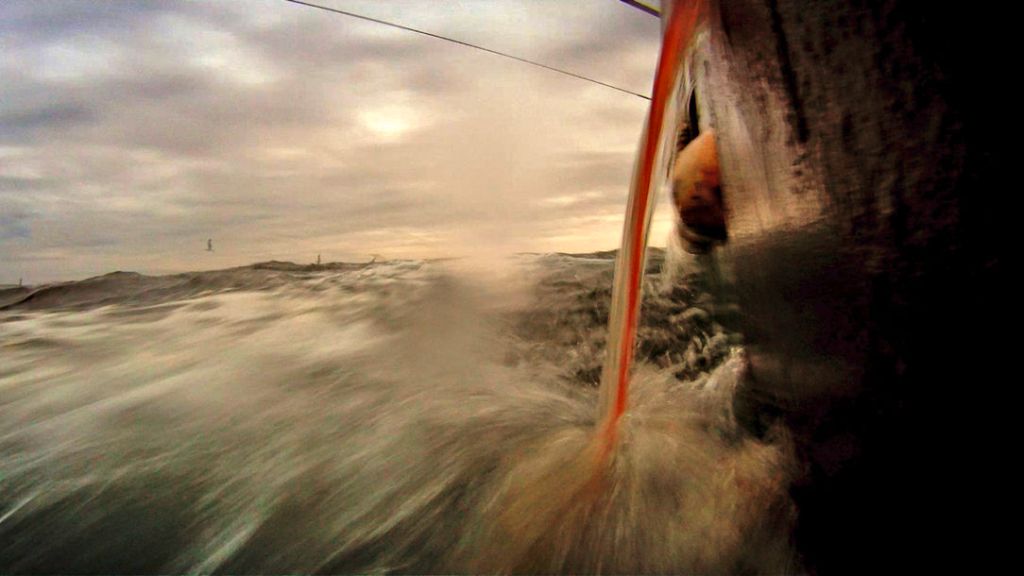
Leviathan 2012

Leviathan, an experimental ethnographic film by Castaing‐Taylor and Paravel, is groundbreaking.

Stevenson and Kohn (2015)

When Gardner released his Forest of Bliss (1986) several anthropologists have questioned its ethnographicness. Using no voice-over narration, no subtitled dialogue, inter-titles or anything that could directly explain what the images unfolded, the filmed was hailed as aesthetically rich but ethnographically poor. Gardner reacted with a letter where he stated: ‘I wonder if the time may not have come for members of certain orthodoxies in Anthropology to rethink their threadbare doctrines.’

One of the persons who took this remark seriously is anthropologist Lucien Castaing-Taylor, and his ‘groundbreaking’ ‘experimental ethnographic film’ Leviathan (2012), co-directed with Venera Paravel is the ultimate proof. His article on the iconophobia of anthropologists is in many way a response to Gardner’s critics and an articulation of a different way of making ethnographic film. He (Castaing-Taylor 1996, 86) asks “what if film not only constitutes discourse about the world but also (re)presents experience of it? What if film does not say by show? What if film does not just describe, but depict?”. For him in a film “acts of moving, hearing, and seeing are at once presented and represented as the originary structure of embodied existence and the mediating structures of discourse” (Castaing-Taylor 1996, 80). This double characteristic of presenting and representing experience makes film “fit to exploring existence in all its ambiguity, fit for expressing the undifferentiated significance of the human condition; fit, that is, to simultaneously embodying and evoking intuitive lived experience” (Castaing-Taylor 1996, 80, emphasis added).

In the introduction of the book he co-edited with Ilisa Barbash on the cinema of Gardner, Forest of Bliss is described as a great achievement of what film is for Castaing-Taylor in ‘Iconophobia’. The film is “the apogee of Gardner’s efforts to recognize the polyvalency of the (aural and visual) images themselves, unmediated by any verbal exegesis circumscribing their meaning.” But more than that, “because of the absence of narration or even translated dialogue, the film virtually demands the viewer to respond nonverbally and , in certain respects, even viscerally. As such, it stimulates an interplay of the senses with an uncommon intensity” (Barbash and Castaing-Taylor 2007, 6, emphasis added).

He held two important institutional positions since the 1990s that allowed him to carve a place in the discipline for this kind of evocative ethnographic film: (1) founding editor of Visual Anthropology Review (1991-1994), the journal of American Anthropological Association’s Society for Visual Anthropology (SVA), which grew out of the SVA’s Newsletter where the debates between anthropologists over Forest of Bliss took place; (2) and director of The Film Study Center at Harvard since 2002, the institution that Gardner helped establish and directed between 1957-1997. The success of Castaing-Taylor’s endeavour culminated in the establishment of the Sensory Ethnographic Lab at Harvard and the widely acclaimed Leviathan.

In this experimental study of commercial fishing in the North Atlantic, Castaing‐Taylor and Paravel have unquestionably taken the tradition of ethnographic cinema into new domains.

Westermoland and Luvaas (2015)

Unlike the discussion around Gardner’s Forest of Bliss, this kind of evocative film occupies an experimental slot that makes the reception of the film by anthropologists more positive. Like the savage slot that defines utopia and order (Trouillot 1991), the experimental slot defines ethno-fiction and ethnographic science, art and documentary. Trouillot (1991) has argued that the savage becomes real, enters into existence, as a metaphor mobilised in the construction of utopias, themselves metaphors for ideal fictionalised states of being projected against or in favour of the Enlightenment universal order of things. Likewise, experimental ethnography exists in relation to ethno-fiction and ethnographic science and occupies a structurally defined slot in the disciplinary order of anthropology. Leviathan is neither totally artistic, nor devoid of ethnographic documentation. Neither an orchid, nor a lettuce. But it is, as most of the authors in the special issue of Visual Anthropology Review claim, experimental.

The muddled boundaries between documentary and experimental film that Leviathan exemplifies also fit in with dominant discourses on color and cinema, equally preoccupied with the reproduction of reality as with the aesthetic possibilities for chromatic experimentation and abstraction.

Hanssen (2015)

References

Barbash, Ilisa, and Lucien Castaing-Taylor. 2007. The cinema of Robert Gardner. Oxford: Berg.

Castaing-Taylor, Lucien. 1996. Iconophobia. Transition. 6 (69): 64-88.

Hanssen, Eirik Frisvold. 2015. “His eyes are like the rays of dawn”: color vision and embodiment in “Leviathan”. Visual Anthropology Review. 31 (1): 20-26.

Stevenson, Lisa, and Eduardo Kohn. 2015. “Leviathan”: an ethnographic dream. Visual Anthropology Review. 31 (1): 49-53.

Trouillot, Michel-Rolph. 1991. Anthropology and the savage slot the poetics and politics of otherness. Recapturing Anthropology. Working in The Present. Fox, G. R. (ed.). Santa Fe, New Mexico: School of American Research Press.

Westmoreland, Mark R., and Brent Adam Luvaas. 2015. “Introduction: “Leviathan” and the entangled lives of species”. Visual Anthropology Review. 31 (1): 1-3.

Mistaking an orchid for a lettuce

Is Gardner’s Forest of Bliss (1986) an ethnographic film? Following the tripartite division of a film made by Banks (1992), which I used in the previous entry to analyse Gardner’s Dead Birds (1963) to identify where its ethnographicity resides, I argue that Forest of Bliss (1986) has not been immediately perceived as an (good) ethnographic film (Moore 1989, Parry 1989, Ruby 1989) because its ethnographicity does not reside in its intention, nor its event, neither in the reaction to watching the film. But where?

I said in my previous post that the use of images as ethnographic documents in Dead Birds and the narrative structure employed is what made me see that film’s resemblances with an ethnographic contemporary text. In Forest of Bliss, although the film is structured in a similar narrative manner, images are not explained, nor interpreted, nor really used to illustrate abstract concepts. Commentary is completely abandoned. It thus becomes harder to distinguish the way in which images are used or if they are used at all as ethnographic documents.

An interesting video essay from Kevin B. Lee on the transformations of Gardner’s documentary filmmaking, looking at Dead Birds (1963), Rivers of Sand (1974) and Forest of Bliss (1986):

All images are documents of some sort in the end, but what makes them ethnographic documents though is the way in which the image-documents are used. Having said that, is there something ethnographic about Forest of Bliss? Peter Loizos (1992, 58) claims that ‘[i]t has simply been an error of judgement, and a category mistake, to treat this film as an ethnographic film gone wrong. It never tried to be one. The mistake is like mistaking a novel for a medical treatise, a racehorse for a work-horse, an orchid for a lettuce’.

But what if one imagines ethnography, following Stephen Tyler (1986, 125) as ‘a cooperatively evolved text consisting of fragments of discourse intended to evoke in the minds of both reader and writer an emergent fantasy of a possible world of common sense reality, and thus to provoke an aesthetic integration that will have a therapeutic effect’? What if ethnography ‘defamiliarizes common sense reality in a bracketed context of performance, evokes a fantasy whole abducted from fragments, and then returns participants to the world of common sense—transformed , renewed , and sacralized.’? (Tyler 1986, 126)

The film seems to do precisely this to a certain extent. As Parry (1989 , my emphasis) confesses, the film made him ‘re-live‘ something that he ‘experienced‘ in his first weeks of fieldwork: ‘scenes and events which I found both boringly protracted yet endlessly fascinating, occasionally somewhat distasteful and frequently of striking beauty – though above all the film evokes the intense frustration of initial incomprehension”. Loizos (1992, 58) also claims that the film’s ‘aim is to evoke thoughts in us by sounds and images, but not to tell us in formal conceptual terms what to think, or what to make of it’. The audience of Forest of Bliss, according to Crawford (1992, 77), is invited to ‘understand and sense other cultures by emphasising analog forms of representation open to interpretation’.

Forest of Bliss shows that what Tyler imagines ethnography, or more precisely post-modern ethnography to be can be achieved in film. But can it be achieved in writing? And would this particular post-modern ethnographic text be recognised as ethnography? If anthropologists found it hard to identify Forest of Bliss as a post-modern ethnography then it would be even hard to identify a textual version of Tyler’s post-modern ethnography as such. Anthropologists have been more at ease with identifying this film as art than as ethnography. Maybe this is the reason why the more experimental contemporary ethnographies have found their place in the art field rather than in anthropology. But, to quote Gardner’s response to the critique of Moore (1989), ‘I wonder if the time may not have come for members of certain orthodoxies in Anthropology to rethink their threadbare doctrines.’

References

Banks, M. 1992. Which films are ethnographic films? In Film as Ethnography, Crawford, P. I. and Turton, D. Manchester: Manchester University Press.

Crawford, P. I. 1992. Film as discourse: the invention of anthropological realities. In Film as Ethnography, Crawford, P. I. and Turton, D. Manchester: Manchester University Press.

Loizos, P. 1992. Admisible evidence? Film in anthropology. In Film as Ethnography, Crawford, P. I. and Turton, D. Manchester: Manchester University Press.

Moore, A. 1989. The limitations of imagist documentary. A review of Robert Gardner’s Forest of Bliss‘. Society for Visual Anthropology Newsletter, V(1)

Parry, J. 1989. ‘Comment on Robert Gardner’s Forest of Bliss‘. Society for Visual Anthropology Newsletter, V(1)

Ruby, J. 1989. The emperor and his clothes. A commentary.’ Society for Visual Anthropology Newsletter, V(1)

Tyler, A. S. 1986. Post-modern ethnography. From document of the occult to occult document. In Writing Culture. The Poetics and Politics of Ethnography, Clifford, J. and Marcus, G. (eds.). Berkeley: University of California Press.

Images as ethnographic documents

Watching Dead birds (1963) and To Live with Herds (1972) I was surprised to see how much the former resembles a contemporary ethnographic text and how little the latter. Where does the ‘ethnographicity’ of these films reside? Banks (1992) argues that a film is the outcome of a process that can be divided in three parts: the intention to shoot a film, which leads to the event of making it and the reaction to the final result. In which part of Gardner’s film resides the ethnographicity that makes it resemble a contemporary ethnographic text and in which part does it reside in MacDougalls’ film? Is ethnographicity present in the intention behind making the film, the event of making it or the reactions to the final product?

Gardner’s intention to salvage disappearing cultures with his cinematic practice and his reification of the film’s subjects in images which are used to support a general statement about humanity is far from what one would see in today’s ethnographies. Moreover, intervening in the subjects’ everyday life to direct their actions in order to enact the subject-image sought sounds outrageous to the present day anthropologists. His entire filmography has been criticised for these reasons and Jay Ruby’s (1991) essays are exemplary in this regard.

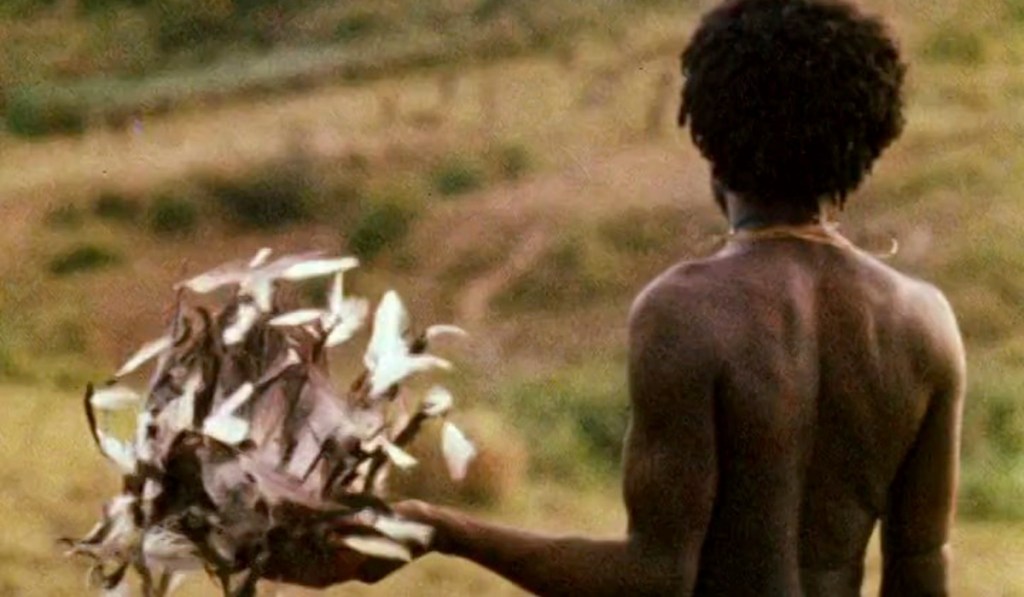
Dead Birds

Another reason for which Ruby (1991, 6-7) and other anthropologists criticised Gardner’s work was his usage of commercial feature fiction conventions to edit his films. Ruby argues that the film is ‘constructed out of what is deemed necessary in order to have the film’s thesis look convincing’. This means that in order to deliver a compelling and comprehensive linear narrative Gardner fabricates the illusion of having shot coherent events by imposing meaning on disparate images. One example of this is the battle scene stopped by the rain. In this scene Gardner intercuts images from the battle field with images from the village where one of the film’s main characters is leaving his house to reach the battle. It would have been impossible for Gardner to shoot both scenes at the same time. The spatial unity of the scene is abandoned in favour of rhetorical unity which is achieved through a staging of the house leaving shot. This of course raises questions about the veracity of the scene and the capacity of the film to act as a record of reality that is not influenced or distorted by the filmmaker.

Ruby’s and other anthropologists’ critique of Dead Birds is addressed from the standpoint of the observational mode of documentary film, which evolved in contradistinction to the expository mode of Gardner’s film (Nichols 1991). Vaughan (1992, 100) argues that although the observational mode claimed to provide an unmediated relationship between the viewer and the film as record of reality few filmmakers adopted this stance. However, observational filmmaking ‘rested on the assumption, implicit or explicit, that the inevitable selectivity of shooting may be counteracted, or perhaps, merely atoned for, by a refusal of selectivity in editing: that the minimum structuring will afford the maximum of truth’. By the late 1960s this became the main mode of ethnographic filmmaking and to some extent it is still the main mode today.  

In terms of intention, which is to observe the everyday life of people, and engagement with the subjects of the research, be as less intrusive as possible and guide the structure of the film according to the unfolding of their actions, observational film is more close to the contemporary ethnographic text. In fact, some have argued that observational filmmakers were the forerunners to the discussions about what sort of representations are ethnographic texts initiated by Clifford and Marcus (1986) in Writing Culture (Ginsburg 1998, Wright 1997).

David and Judith MacDougall’s first film To Live with Herds (1972) is considered a classic of the observational mode. Grimshaw and Ravetz (2009) description of what makes this film observational points out  the main difference between the expository and the observational mode in terms of cinematic conventions employed. They say that ‘MacDougall sought to preserve the integrity of events and encounters witnessed’, rather than to deliver a compelling argument. In this manner the film is also ‘inviting viewers to engage with the materials on their own terms’ , instead of imposing meanings to the images in order to enroll them into a general argument, while ‘the relationship between the different parts [of the film] was not then straightforwardly linear, but emerged as a series of variations in theme and tempo’ (Grimshaw and Ravetz 2009, 83-84).

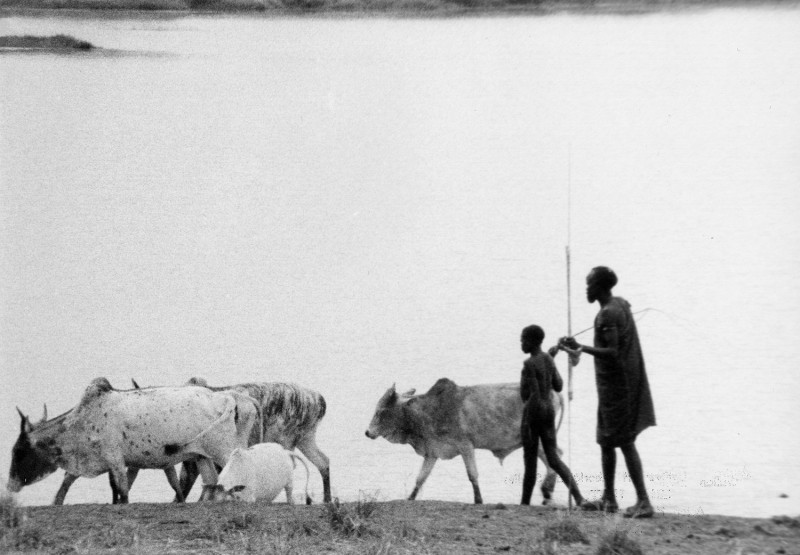
To Live with Herds

I believe that what makes Dead Birds resemble a contemporary ethnographic text more than To Live with Herds resides in the reaction part of the film process, rather than in intention or event. On one hand, Dead Birds, like ethnographic texts, uses a voice over, representing the ‘author’s’ voice. It explains the visual material or uses the visual material to support what the voice over is saying. Moreover, the visual material illustrates abstract ideas. For example, a juxtaposition of images of a puddle in which rain drops are falling followed by an image of a banana tree are used as visual metaphors for the idea that the human soul is conceived as a seed that grows in time. The voice over is always present throughout the film interpreting the images. On the other hand, To Live with Herds only provides explanations of images in intertitles at the beginning of each film segment, in which several scenes illustrate through images and overhead conversations or interviews what was mentioned in the intertitles. Sometimes a voice over is used to give information that was not captured by the camera. For example in the cattle market scene when at the end of the scene the voice over mentions that a buyer was ask if the cattle auction was successful or not and continues with the reply of the buyer over images that depict the market, the cattle and the people.

Images in Dead Birds are treated as ethnographic documents that need to be interpreted, just like fieldwork notes are interpreted in a text. Like ethnographic description made from various notes, a scene is fabricated from different observations and are embedded into a narrative that delivers the argument of the scene and each individual scene is placed into the overall narrative that supports delivers argument of the entire film. The voice over is overtly used throughout the film as the ‘author’s’ interpretative voice. In To Live with Herds instead, the interpretation appears at the beginning of each part in the form of intertitles which because of their formal style are less easily attributed to the ‘author’s’ voice and can be read as not interpreting the images that follows them. It feels like each part follows the IMRaD (Introduction, Methods, Results and Discussion) style of writing of the scientific text. Moreover, when the voice over appears, stylistically more personalised than the intertitles or than the ‘voice-of-God’ in Dead Birds, it is used to add more information, similar to a footnote, rather than to interpret the images. Hence the reason my reaction to seeing Dead Birds as more ethnographic has to do with employing conventions of using ethnographic documents that, interestingly enough, only during the 1990s will become mainstream in the ethnographic text (see for instance the article of Besnier (and Morales 2018), editor of the American Ethnologist, about how to write a publishable text for the journal). Gardner interprets the images and embeds them in a narrative, while the MacDougalls refrain from interpretation, or tend to veil it, as much as possible and refuse to create a narrative.

As Vaughan (1992, 100-101) has noticed ‘we may, indeed, find it a little puzzling that anthropology should have taken so readily to observational modes of film-making at all, when it might, as a science, have been expected to prefer the traditional patterns whose tight organisation of proto-fictional (or at any rate proto-demonstrative) materials promises to raise the general principle above the vagaries of the particular instances’. Although, to some extent the discipline of anthropology has discarded pretences to be a hard science and accommodates looser structures of argumentative reasoning, it is nonetheless geared in its textual form towards some form of generalisation that requires more tightness in the organisation of its ethnographic documents, more than what some anthropologists might want from their materials, more than the observational film conventions offers. Gardner’s usage of images which are embedded into a narrative that delivers the argument is much more similar to what the ethnographic text turned to in anthropology’s post-positivist era.

Whether the ethnographic film should be different from the ethnographic text, or whether the ethnographic text should be more akin to observational film is a related but somewhat different discussion.

References

Banks, M. 1992. Which films are ethnographic films? In Film as Ethnography, Crawford, P. I. and Turton, D. Manchester: Manchester University Press.

Besnier, N. and Morales, P. 2018. Tell the Story. How to Write an Article for American Ethnologist. American Ethnologist 45(2): 163-172.

Clifford, J. and Marcus, G. eds. 1986. Writing Culture. The Poetics and Politics of Ethnography. Berkeley: University of California Press.

Ginsburg, F. 1998. Institutionalizing the Unruly. Charting a Future for Visual Anthropology. Ethnos 63(2): 173-196.

Grimshaw, A. and Ravetz, A. 2009. Observational Cinema. Anthropology, Film, and the Exploration of Social Life. Bloomington: Indiana University Press.

Nichols, B. 1991. Representing Reality. Issues and Concepts in Documentary. Bloomington: Indiana University Press.

Ruby, J. 1991. An Anthropological Critique of the Films of Robert Gardner. Journal of Film and Video 43(4): 3-17.

Vaughan, D. 1992. [1978/79]. The aesthetics of ambiguity. In Film as Ethnography, Crawford, P. I. and Turton, D. Manchester: Manchester University Press.

Wright, C. 1998. The Third Subject. Perspectives on Visual Anthropology. Anthropology Today 14(4): 16-22.