
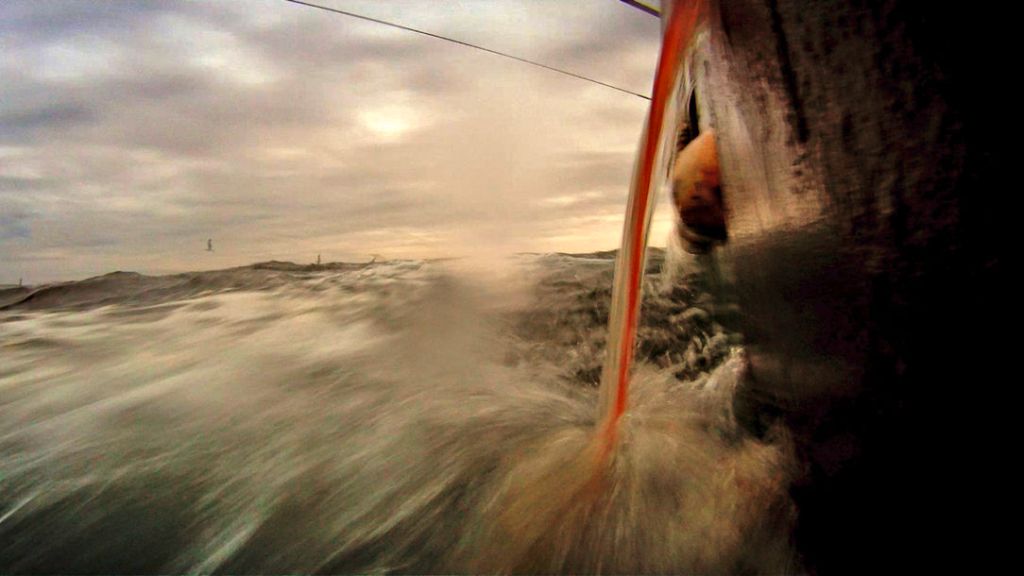
Leviathan, an experimental ethnographic film by Castaing‐Taylor and Paravel, is groundbreaking.
Stevenson and Kohn (2015)
When Gardner released his Forest of Bliss (1986) several anthropologists have questioned its ethnographicness. Using no voice-over narration, no subtitled dialogue, inter-titles or anything that could directly explain what the images unfolded, the filmed was hailed as aesthetically rich but ethnographically poor. Gardner reacted with a letter where he stated: ‘I wonder if the time may not have come for members of certain orthodoxies in Anthropology to rethink their threadbare doctrines.’
One of the persons who took this remark seriously is anthropologist Lucien Castaing-Taylor, and his ‘groundbreaking’ ‘experimental ethnographic film’ Leviathan (2012), co-directed with Venera Paravel is the ultimate proof. His article on the iconophobia of anthropologists is in many way a response to Gardner’s critics and an articulation of a different way of making ethnographic film. He (Castaing-Taylor 1996, 86) asks “what if film not only constitutes discourse about the world but also (re)presents experience of it? What if film does not say by show? What if film does not just describe, but depict?”. For him in a film “acts of moving, hearing, and seeing are at once presented and represented as the originary structure of embodied existence and the mediating structures of discourse” (Castaing-Taylor 1996, 80). This double characteristic of presenting and representing experience makes film “fit to exploring existence in all its ambiguity, fit for expressing the undifferentiated significance of the human condition; fit, that is, to simultaneously embodying and evoking intuitive lived experience” (Castaing-Taylor 1996, 80, emphasis added).
In the introduction of the book he co-edited with Ilisa Barbash on the cinema of Gardner, Forest of Bliss is described as a great achievement of what film is for Castaing-Taylor in ‘Iconophobia’. The film is “the apogee of Gardner’s efforts to recognize the polyvalency of the (aural and visual) images themselves, unmediated by any verbal exegesis circumscribing their meaning.” But more than that, “because of the absence of narration or even translated dialogue, the film virtually demands the viewer to respond nonverbally and , in certain respects, even viscerally. As such, it stimulates an interplay of the senses with an uncommon intensity” (Barbash and Castaing-Taylor 2007, 6, emphasis added).
He held two important institutional positions since the 1990s that allowed him to carve a place in the discipline for this kind of evocative ethnographic film: (1) founding editor of Visual Anthropology Review (1991-1994), the journal of American Anthropological Association’s Society for Visual Anthropology (SVA), which grew out of the SVA’s Newsletter where the debates between anthropologists over Forest of Bliss took place; (2) and director of The Film Study Center at Harvard since 2002, the institution that Gardner helped establish and directed between 1957-1997. The success of Castaing-Taylor’s endeavour culminated in the establishment of the Sensory Ethnographic Lab at Harvard and the widely acclaimed Leviathan.
In this experimental study of commercial fishing in the North Atlantic, Castaing‐Taylor and Paravel have unquestionably taken the tradition of ethnographic cinema into new domains.
Westermoland and Luvaas (2015)
Unlike the discussion around Gardner’s Forest of Bliss, this kind of evocative film occupies an experimental slot that makes the reception of the film by anthropologists more positive. Like the savage slot that defines utopia and order (Trouillot 1991), the experimental slot defines ethno-fiction and ethnographic science, art and documentary. Trouillot (1991) has argued that the savage becomes real, enters into existence, as a metaphor mobilised in the construction of utopias, themselves metaphors for ideal fictionalised states of being projected against or in favour of the Enlightenment universal order of things. Likewise, experimental ethnography exists in relation to ethno-fiction and ethnographic science and occupies a structurally defined slot in the disciplinary order of anthropology. Leviathan is neither totally artistic, nor devoid of ethnographic documentation. Neither an orchid, nor a lettuce. But it is, as most of the authors in the special issue of Visual Anthropology Review claim, experimental.
The muddled boundaries between documentary and experimental film that Leviathan exemplifies also fit in with dominant discourses on color and cinema, equally preoccupied with the reproduction of reality as with the aesthetic possibilities for chromatic experimentation and abstraction.
Hanssen (2015)
References
Barbash, Ilisa, and Lucien Castaing-Taylor. 2007. The cinema of Robert Gardner. Oxford: Berg.
Castaing-Taylor, Lucien. 1996. Iconophobia. Transition. 6 (69): 64-88.
Hanssen, Eirik Frisvold. 2015. “His eyes are like the rays of dawn”: color vision and embodiment in “Leviathan”. Visual Anthropology Review. 31 (1): 20-26.
Stevenson, Lisa, and Eduardo Kohn. 2015. “Leviathan”: an ethnographic dream. Visual Anthropology Review. 31 (1): 49-53.
Trouillot, Michel-Rolph. 1991. Anthropology and the savage slot the poetics and politics of otherness. Recapturing Anthropology. Working in The Present. Fox, G. R. (ed.). Santa Fe, New Mexico: School of American Research Press.
Westmoreland, Mark R., and Brent Adam Luvaas. 2015. “Introduction: “Leviathan” and the entangled lives of species”. Visual Anthropology Review. 31 (1): 1-3.
 twitchingeyes